
Every journey begins with a first step. The first step towards a garden — all the more so an organic one, and a SCHOOL one at that — is planning. That is why our project began with a series of workshops on planning a school eco-garden.
Planning calls for some knowledge, above all knowledge of organic gardening.
A second kind of knowledge — design knowledge proper — comes from permaculture. Here you can read what permaculture actually is.
To help with planning an eco-garden at a school or kindergarten we have prepared the chapter Zone planning, which sets out the principles of permaculture design from the point of view of a school or kindergarten.
Once we know the basic principles of organic gardening and permaculture design, we step into the real space available to us. And there our creativity has plenty of room!

Organic gardening
 A school eco-garden will most likely not enter the certification system, since our purpose is not to grow for sale: the purpose of our eco-gardening is to educate.
Even so, we must work according to the principles of organic farming, or we would be teaching children the wrong thing. Soil is irreplaceable: a natural resource, a natural asset, and the ground on which human life and development rest.
Growing food on organic principles preserves the natural fertility of the soil and prevents the environmental burden of excessive mineral and organic fertilisers and plant protection products.
Organic farming is very well presented on the European Commission website, in Slovenian as well. Recommended!
The project Pridelano in prodano doma, carried out in 2009 by the Posočje Development Centre together with the Municipality of Tolmin, also produced a publication with useful information on growing healthy, good-quality food: soil preparation, fertilising, composting, crop rotation, choosing, buying and storing seed, natural plant protection and more.
Publication: Pridelano doma – Učbenik.pdf
A school eco-garden will most likely not enter the certification system, since our purpose is not to grow for sale: the purpose of our eco-gardening is to educate.
Even so, we must work according to the principles of organic farming, or we would be teaching children the wrong thing. Soil is irreplaceable: a natural resource, a natural asset, and the ground on which human life and development rest.
Growing food on organic principles preserves the natural fertility of the soil and prevents the environmental burden of excessive mineral and organic fertilisers and plant protection products.
Organic farming is very well presented on the European Commission website, in Slovenian as well. Recommended!
The project Pridelano in prodano doma, carried out in 2009 by the Posočje Development Centre together with the Municipality of Tolmin, also produced a publication with useful information on growing healthy, good-quality food: soil preparation, fertilising, composting, crop rotation, choosing, buying and storing seed, natural plant protection and more.
Publication: Pridelano doma – Učbenik.pdf

Why grow your own organic food
Grow healthy, wholesome food that tastes better into the bargain!
Many studies show that, unlike conventional food, organically grown food contains practically no residues of synthetic chemical pesticides, because organic growers do not use them. There is also a good reason why so many top chefs use organic ingredients: they taste better. Organic farming looks first of all after the health of the soil, which is the foundation for healthy plants and, in turn, for our own bodies.
Save money!
Growing your own food cuts the monthly bill at the supermarket. Instead of spending a lot of money and, above all, time shopping, spend your free time outdoors on your own organically tended bed. You get exercise and a sense of well-being along the way.
Protect future generations!
Children are on average four times more exposed than adults to at least eight commonly used cancer-causing pesticides in food. The food you choose for your children today also shapes their health in the future.
“We have not inherited the Earth from our fathers, we have borrowed it from our children.” (Lester Brown)
Organic farming and gardening prevent soil erosion!
In developed countries soil erosion — the wearing away of soil by torrents and rivers, wind and ice — now runs faster than the soil can renew itself. Fertile soil is the foundation of the food chain in organic farming. In conventional farming the soil serves mainly as something for the plant to stand in, which makes chemical treatment easier. As a result many farms around the world are suffering the worst soil erosion in history.
Protecting water quality!
Water makes up two thirds of our body weight and three quarters of our planet. Disease-causing pesticides, cancer among them, contaminate groundwater and the main sources of drinking water. Pesticides are also a problem in treating waste water and in preparing water for drinking.
And what about energy efficiency?
Organic farmers already contribute a great deal  to energy efficiency and climate protection. Many provisions of organic farming rules and legislation are aimed at this, such as limits on concentrated feed and the ban on synthetic mineral fertilisers and pesticides.
Conventional agriculture consumes far more oil than any other sector, a considerable share of total energy use. Today much more energy goes into producing synthetic chemical fertilisers than into working the land and bringing in the harvest.
Because it uses no synthetic fertilisers, organic farming avoids CO2 emissions on the one hand, and on the other reduces the amount of this climate-damaging gas in the atmosphere by storing carbon in the soil.
Growing your own food in town or country, or buying from a local organic farmer, also cuts transport costs and the pollution that goes with them. Growing your own gives you full control: which seed or seedling you used, how you cared for the soil, which (green) manure you applied.
Take the “chemicals” off your plate!
Choosing organic food is a wise decision, above all for the most vulnerable groups and especially children, because:
— relative to body weight they take in more pesticide residues;
— their defence mechanisms are not yet fully developed;
— the combined (synergistic) effects of several pesticides are not taken into account when “safe thresholds” are set, even though food often contains residues of five or more active substances;
— in organic production synthetic pesticides are prohibited.
Protect workers and support small farms!
At the end of 2013 some 3,000 farms in Slovenia were farming organically, working 38,000 hectares of agricultural land in total (Ministry of Agriculture and the Environment, 2014). The pace of organic farming’s growth in Slovenia has fluctuated a good deal, and analysis shows we shall fall far short of the targets set in the 2005 Action Plan for the Development of Organic Farming, which envisaged 15% organic farms, 20% organically farmed land and even 10% Slovenian organic food on the shelves by 2015.
Farmers exposed to herbicides run a  much higher risk of cancer than others. Cases of pesticide poisoning among farmers peaked during the so-called green revolution, when synthetic chemical preparations and pesticides were used in large quantities in both mass and home food production.
Our farming structure has a history and tradition worthy of respect — smaller family farms — and many people still feel closely tied to the land. Of roughly 70,000 farms in Slovenia, as many as 50,000 are small farms that are not really active. The future of Slovenian agriculture should rest on giving those small farms particular help to become organic and biodynamic, which could do much to increase food production and processing and so improve self-sufficiency and food security.
A boost for biodiversity!
 Monoculture means growing the same plant on a large area of land year after year. While the monoculture approach tripled global agricultural output between 1950 and 1970, the lack of plant diversity took its toll on the quality of the land, which lost minerals and nutrients. Because this way of farming exhausts the soil, farmers use chemical fertilisers, often in large quantities, to replace what has been lost. Monocultures are more prone to pests, so conventional farmers use pesticides on top of that. In America, for instance, crop losses to insects doubled between 1947 and 1974 despite a tenfold increase in pesticide use — partly because some insects became genetically resistant to particular pesticides.
Help your garden and your community flourish!
Beyond what they produce, community organic gardens are a pleasure to look at: they brighten and, above all, gladden our families, our community, a whole town or village.
Adapted from the article “Top 10 reasons to grow your own organic food” (URL: http://www.realfarmacy.com/top-10-reasons-to-grow-your-own-organic-food/)
What is permaculture?
 Permaculture is a way of creating balanced environments. It establishes a balanced relationship between:
- ETHICS
- ECOLOGY
- ECONOMICS.
Zone planning
Zone planning means arranging things according to how often we need them and how much work they take to maintain.
Areas we have to visit every day should be close by, while those we visit rarely can be further off.
When we sort things into zones we start from a central point, in our case the school. The heart of efficient energy planning is placing plants, animals and particular structures according to zone.
In permaculture, efficient energy planning is one of the basic principles, and it includes zoning.
The golden rule is to sort out the immediate surroundings first, and only then turn to the wider area. Much depends, of course, on the space the school has. Besides the building itself, which is zone 0, most schools have at least zones 1 and 2.
[line]
Zone 0
is the centre of activity: in our case the school building. Since our subject is school eco-gardens, this covers the school rooms connected with the garden. How much is included depends on the needs set out in our earlier plans. It certainly takes in the kitchen with everything needed to prepare food, and may include other rooms where food is stored, grown in part or from time to time, or where waste is separated.
Zone 0 lies within the building.

[line]
Zone 1
is the area immediately around the school building. It is also the most intensively tended and most often used. Here we have:
- the ornamental, herb and vegetable garden, and perhaps a small tree or two,
- the compost bin.
Zone 1 also has room for:
- fuel, or access for fuel deliveries,
- rainwater butts fed from existing roofs, and taps,
- space for free time (a grassed area for play),
- an outdoor classroom, or one under a purpose-built roof.

[line]
Zone 2
is still intensively maintained, but it is larger, further from the building, and holds everything zone 1 cannot accommodate on the same scale.
These are:
- the playing field,
- the garden, including fruit,
- water butts and taps,
- the greenhouse,
- učilnica na prostem ali na posebej narejenem prostoru pod streho,
- a place for tools,
- shelter for farm animals,
- a place to store animal feed,
- compost bins.

[line]
Zone 3
is the part of the school grounds where, besides playing fields, there may be room for the fruit garden and for raising fruit trees. Here too we need roofed areas for shelter from sun and rain, and water butts.

[line]
Zones 4 and 5
are the zones where it makes sense to let nature come into its own. Alongside grassland there is room for fruit and forest trees, for a larger number of farm animals, and for wildlife. Farm animals in particular need a roof over their heads.

[line]
Zone 5
We let it run itself. Here we are only visitors.
Examples of eco-garden layouts
Shelter — an insect “hotel”
An insect hotel is an indispensable part of every school eco-garden. It is made up of simple shelters for the many insects we particularly want in an eco-garden: those that keep the garden ecosystem in balance, and some that pollinate the flowers. The best-known single-species insect hotel is, of course, the beehive. The insects we would rather not see in large numbers are those that feed on our plants: aphids, some beetles, nematodes. If we make sure the garden or field holds enough creatures that feed on those insects or on their eggs and larvae, no pesticides are needed. With a little help from us, nature will keep things in proportion. An insect hotel consists of various shelters suited to the needs of particular species: blocks of wood with drilled holes, wooden tubes, bundles of straw or reed. The whole thing can be large or small, depending on the size of the garden and on how far you want to take it. You can build such a hotel yourselves together with the children, perhaps in a design and technology lesson. The picture below shows an example of an insect hotel.
An eco-garden on the balcony of the Institute for Sustainable Development
 Photo story — a garden on the balcony
Site plans — examples of layouts at Slovenian educational institutions
All the plans were prepared by permaculture designer and teacher Jožica Fabjan. Click the images for a closer look. Example 1: Rogaška Slatina Kindergarten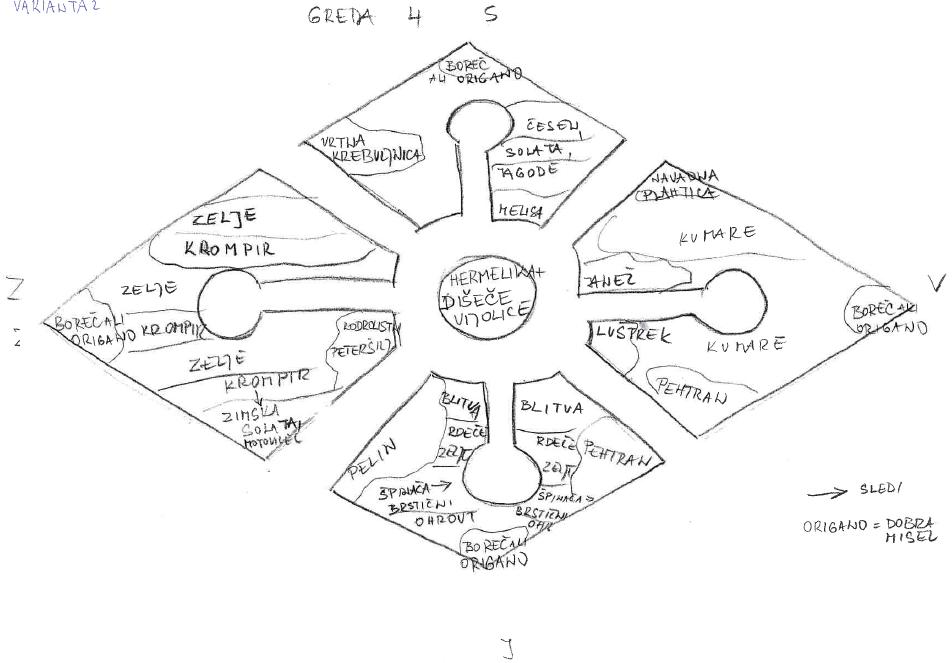 Example 2: Polhov Gradec Primary School
 Example 3: Šiška Grammar School, Ljubljana
